Edition Schwarzer Balken
Werner Lindemann: Mike Oldfield im Schaukelstuhl. Notizen eines Vaters
Werner Lindemann: Mike Oldfield im Schaukelstuhl. Notizen eines Vaters
Couldn't load pickup availability
New edition to mark Werner Lindemann’s 100th birthday
Specifications:
- hardcover with dust jacket
- Dust jacket letterpress-printed on an original 1954 Heidelberg Cylinder press, using silver ink on exceptionally deep-black Fedrigoni paper
- dust jacket illustration by Matthias Matthies
- book covering, endpapers and pastedowns made from Surbalin Cherry Red, printed in one colour (black)
- Smyth-sewn binding with black thread
- pages: 184
- language: German
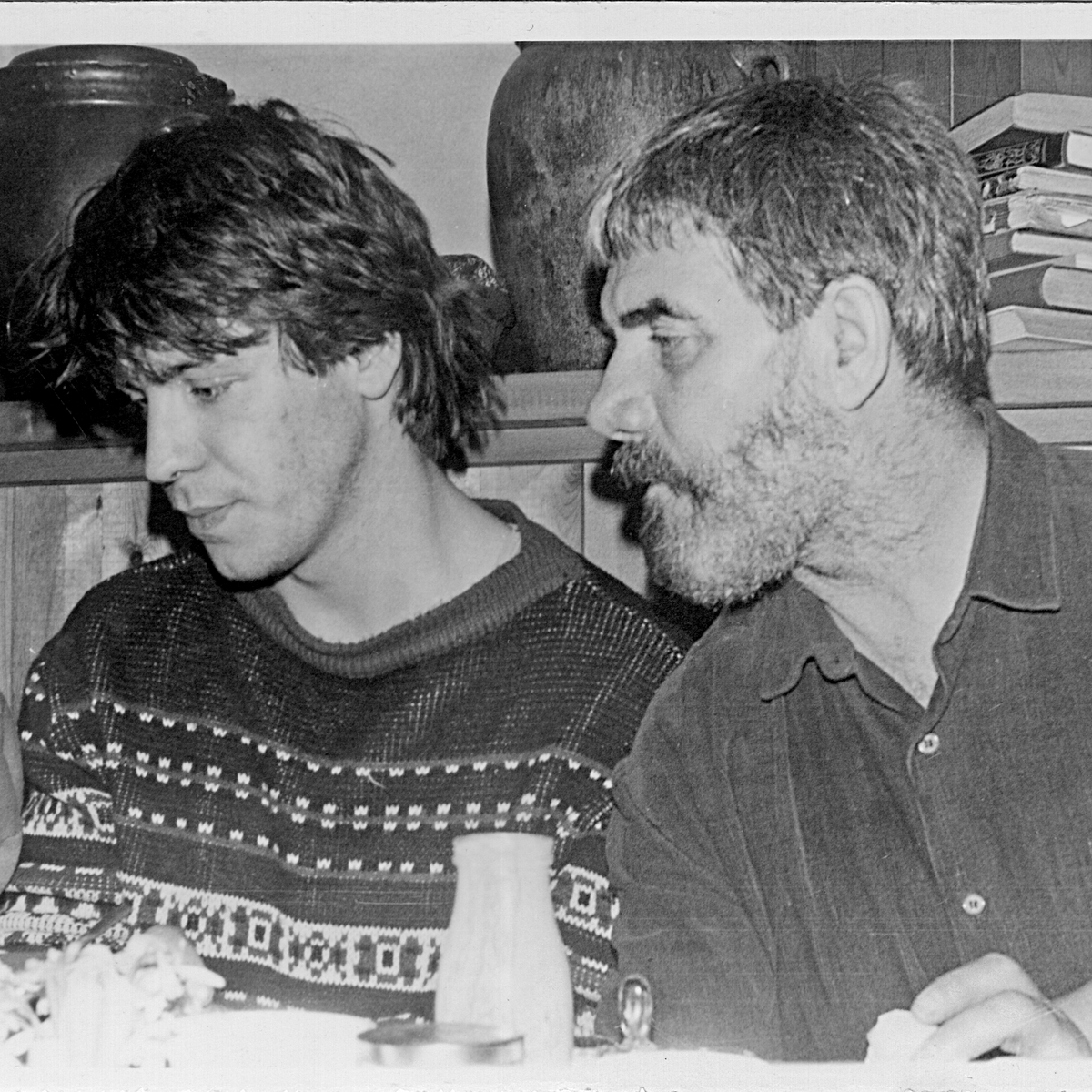
When Werner Lindemann’s book Mike Oldfield im Schaukelstuhl. Notizen eines Vaters was published in East Germany in 1988 by Buchverlag Der Morgen, the focus was not on the future worldwide fame of his son Till Lindemann, but on a difficult yet revealing father-son relationship. Born in 1926, Werner Lindemann was known as a poet and children’s book author. In his book, he reflects on a period in the early 1980s when his then 19-year-old son spent several months living with him in the Mecklenburg countryside. This encounter between two generations gave rise to a literary account of family conflicts, differing views on life, and the search for mutual understanding.
The subtitle Notizen eines Vaters (Notes of a Father) points to the book’s personal and observational narrative style. Lindemann records everyday situations, conversations, confrontations, and moments of reconciliation. What emerges is an encounter between two people whose experiences and expectations are far apart: on one side, the older writer, close to nature and shaped by discipline, work, and the social conditions of East Germany; on the other, the young son, searching for his own path, questioning conventions, and attempting to distance himself from his father’s expectations. Their conflicts can therefore be read as more than merely private family problems. They also reflect the tensions between generations and differing ideas of freedom, responsibility, and self-determination in the later years of East Germany.
The book takes on particular significance through the relationship between memory and literary interpretation. Lindemann recounts their time together from the father’s perspective and thus from an inevitably subjective point of view. His observations offer insights into thoughts and feelings, but also reveal the limits of mutual understanding. It is precisely these contradictions that make the text compelling: closeness and estrangement, affection and frustration, authority and rebellion coexist without ever being easily resolved.
Photo: Werner and Till Lindemann © private
Share